Showing posts with label mary queen of scots. Show all posts

Off with Her Head Answers

1. Everyone knows the assassination of Archduke Franz Ferdinand sparked World War I, but he wasn't the only one to die that day. Who else fell victim to Gavrilo Princip?
Franz Ferdinand's wife, Sophie Chotek Duchess of Hohenberg, was with him that fateful day and suffered the same fate. She is less remembered to history partly because she was not a "royal" wife. Because she was of lower rank, theirs was a morganatic marriage, which meant that she was his legal wife but was denied his rank and style and she came after all of the archduchesses in precedence, even though she was married to the imperial heir. It also meant that their children were legitimate but not royal/imperial dynasts; they could not inherit the throne or their father's titles.

2. Likewise, the whole world is familiar with the Romanov murders in a basement in Ekaterinburg, but they weren't the only imperial victims of the Revolution. Who else met an end at the hands of the Bolsheviks?
We were looking for the one other female imperial victim, Grand Duchess Elizabeth, who had become a nun after her husband, the tsar's uncle Grand Duke Serge Mikhailovich, was assassinated in a bomb attack a few years earlier. Born a princess of Hesse, Elizabeth was also Empress Alexandra's sister. On 17 July 1918, she and several other imperial family members and a couple other people were beaten and shoved into a mine shaft. Hand grenades were then tossed into the mine. According to some accounts, Elizabeth survived the initial attack and was heard to be singing. When the bodies were later discovered, it appeared that she had even bandaged the head of one of the other victims before she died.

There were many other imperial family members who died. As Robyn H., D.C.R.E., points out, "The Bolsheviks clearly learned Revolution 101 from the French." However, they don't seem to have followed the French example of turning executions into public entertainment; most of the imperial murders were carried out in secret and shrouded with disinformation for a long time.

Others who died in the mine with Elizabeth were a different Grand Duke Serge Mikhailovich, the brother Princes John Constantinovich, Constantine Constantinovich and Igor Constantinovich and their cousin Prince Vladimir Pavlovich Paley.

Still more imperial victims included the tsar's uncle Grand Duke Michael Alexandrovich, his great-uncle Paul Alexandrovich, and imperial cousins Grand Dukes Nicholas Mikhailovich, George Mikhailovich, Paul Alexandrovich and Dmitri Constantinovich.

And, as many of you Royal Experts mentioned, the tsar and his family were accompanied by several members of their household: Dr. Eugene Botkin, Anna Demidova, Alexei Trupp and Ivan Kharitonov, who were permitted to stay with the family in their final captivity. Several other loyal retainers had been forced to leave. A pet dog also died with them.

3. Which imperial lady had a deadly encounter with a stiletto while on holiday?
This seems to have been the most challenging question in Royal Expert history. Perhaps it also stumped Google and Wikipedia...
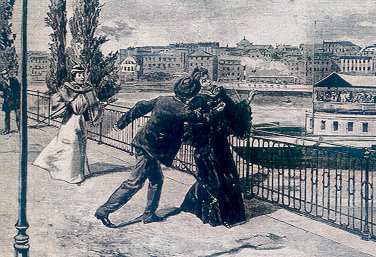
The lady in question is Empress Elizabeth of Austria, often remembered as Sisi. The restless Elizabeth traveled frequently and was especially restless after the murder-suicide of her son Crown Prince Rudolph. (Read Tragic Death on Princess Palace.) On this occasion she was about to board a boat on Lake Geneva when she was stabbed by the mentally ill anarchist Luigi Lucheni whose only goal was to kill a royal. The knife was so small, that no one saw it and initially thought he had just run into her. She was rushed to safety aboard the boat. Wrapped in layers of corsets and clothing, even Elizabeth did not realize she had been stabbed. Then, she had trouble breathing. As clothes were removed, the wound was finally discovered, but it was too late for the boat to reach whatever help might have been available on shore.

4. Six million Jewish people were killed in the Holocaust; but even princesses were subjected to Nazi hatred. Which royal princess died in the concentration camp at Buchenwald?
Technically, Princess Mafalda of Savoy did not die at the hands of the Nazis. However, they had imprisoned her at Buchenwald, where she died of wounds received during an Allied bombing attack on the munitions factory that was being operated at the concentration camp. The 41-year-old princess was the daughter of the Italian king and the wife of Prince Philip of Hesse, who was himself a Nazi. She was traveling without her family when Hitler had her arrested for alleged subversive activities. Her death was not confirmed until Germany's defeat.

5. Henry VIII is famous for beheading his wives, but he wasn't the only queen-killing Tudor. Which queens or former queens were executed by Tudor monarchs?
The Tudors did seem to have a particular penchant for killing former queens. In addition to the two royal consorts--cousins Anne Boleyn and Catherine Howard--deprived of their heads by Henry VIII, two queens regnant also met their fates at Tudor hands. Royal cousin Lady Jane Grey, a teenager who had usurped the throne and reigned for "nine days" after the death of Edward VI, was eventually executed by Queen Mary I, who feared uprisings in Jane's name. In the next reign, Queen Elizabeth I executed another royal cousin, Mary Queen of Scots, who had fled Scotland following her own abdication seeking refuge from Elizabeth. Although Mary was actually Elizabeth's heir, she could not trust her so she imprisoned her. Mary sealed her own fate by conspiring for Elizabeth's death. Eventually, Mary's son succeeded Elizabeth, uniting the thrones of England and Scotland. (For more, read Killing Queens on Princess Palace blog.)

Killing Queens: A Bloody Tudor Heritage

From Holbein
The former queen nodded to the executioner. She turned and faced the crowd that had gathered. Then, she knelt. As a final prayer escaped her, the sharp edge of Tudor vengeance sliced through her neck.

Throughout history, a few kings and queens have met their ends on the executioner’s block, but this manner of death reached epidemic proportions during the Tudor period. Everyone knows that Henry VIII had a penchant for killing his queens—to be fair, he only executed two of his wives—but fewer people are aware that each of his daughters also killed a former queen. In their cases, however, they were killing their own potential heirs.

Henry’s marital mayhem stemmed from his overweening desire to have a male heir to succeed him. He ultimately got one from the third of his six wives, but at the time of his death, the male succession was far from certain. When Henry died, there were only 12 living descendants of the Tudors—only two of them were males: the nine-year-old King Edward VI and the infant Lord Darnley. Six of the remaining 10 were under the age of 13 and, with the low survival rate of young children, any of these youngsters were at risk for an early grave.

With such odds stacked against the survival of the dynasty, it is perhaps surprising that Henry specifically barred three of the dynasts from the line of succession in his final will, skipping over the descendants of his older sister Margaret, who had married the King of Scotland firstly and, after his death, married the Scottish Earl of Angus. Instead, he selected first his children and then the children and grandchildren of his younger sister Mary, who had been married to (and quickly widowed by) the King of France before marrying the Duke of Suffolk.

According to Henry’s will, the line of succession was:

1. Prince Edward, 9, his son by his third wife
2. Princess Mary, 30, his daughter by his first wife
3. Princess Elizabeth, 13, his daughter by his second wife
4. Lady Frances Marchioness of Dorset, 31, oldest daughter of his sister Mary
5. Lady Jane Grey, 9, daughter of Frances
6. Lady Catherine Grey, 6, daughter of Frances
7. Lady Mary Grey, 1, daughter of Frances
8. Lady Eleanor Countess of Cumberland, 27, youngest daughter of his sister Mary
9. Lady Margaret Clifford, 6, daughter of Eleanor

Those that he barred were Margaret Tudor’s granddaughter Mary (four-year-old reigning Queen of Scotland), Margaret’s daughter the Countess of Lennox (31) and the countess’s infant son, Lord Darnley, mentioned above.

Death Of Jane Grey
Many of these people met untimely ends, including King Edward, who reigned for only six years. Before his death, in addition to excluding the Scottish line of the family, he also removed his half-sisters from the list. His cousin, Lady Frances then renounced her rights in favor of her eldest daughter, the now 16-year-old Lady Jane, who was coerced into ascending the throne by her ambitions parents and father-in-law. Popular opinion, however, was against her. The English rose up in favor of Princess Mary. Jane was queen for only nine days.

Mary wished to be lenient with the teenager. Jane was initially spared execution. But, six months later, a rebellion was sparked by Mary’s engagement to the King of Spain. The object of the rebel leaders, who included Jane’s father, was to restore Jane to the throne. The situation left Mary no options. In February, Jane was beheaded. She was the third queen to be executed by a Tudor.

Queen Elizabeth I
Ultimately, Mary had waited too long to try to start a family and she was peacefully succeeded by her half-sister, Elizabeth, who, having witnessed the tumult of her father’s married life as a young child, opted never to marry. Her permanent spinsterhood left the succession to the throne uncertain for more than 40 years. The descendants of Mary Tudor remained the most likely candidates over the Scottish descendants of Margaret Tudor, but nearly every potential heir was subject to the whims of the Virgin Queen. And, one thing the Virgin Queen really did not like was for members of her court, much less her extended family, to get married without her position. They did it any way—both of Lady Jane’s sisters, Lady Catherine and Lady Mary, were imprisoned by Elizabeth for marrying without permission. The aging Countess of Lennox was even imprisoned when each of her sons, Lord Darnley and the Earl of Lennox, married without Elizabeth’s blessing.

Lord Darnley had married his cousin Mary Queen of Scots, thus uniting two claims to the English throne in the body of their child. Darnley was Mary’s second husband; their marriage lasted less than two years before he was murdered, probably at the behest of the Earl of Bothwell, who then kidnapped, raped and married the pregnant Mary in order to control Scotland. Within months, Mary miscarried twins and was forced to abdicate in favor of her son by Darnley, the infant King James VI.

Chopping Block
Mary escaped to England where she sought Elizabeth’s protection. Instead, Elizabeth put her on trial for Darnley’s murder and, though the trial reached no conclusion, Elizabeth imprisoned her queenly cousin. For the next 20 years, Elizabeth used Mary’s potential release as a political tool—she also used her own potential marriage in this way, offering to marry and then reneging for political gain. From prison, Mary grew increasingly careless in her own plotting to overthrow Elizabeth and take her throne. Elizabeth reluctantly signed Mary’s death warrant.

As the executioner struck the fatal blow, Mary whispered, “Sweet Jesus.” Thus, she became the fourth and final queen to lose her head to a Tudor.